The 2027 Chevrolet Silverado HD Is All About Confidence: Driven
Don’t let the carryover skin fool you—big changes make Chevy's stoutest truck makes like easier for owners.
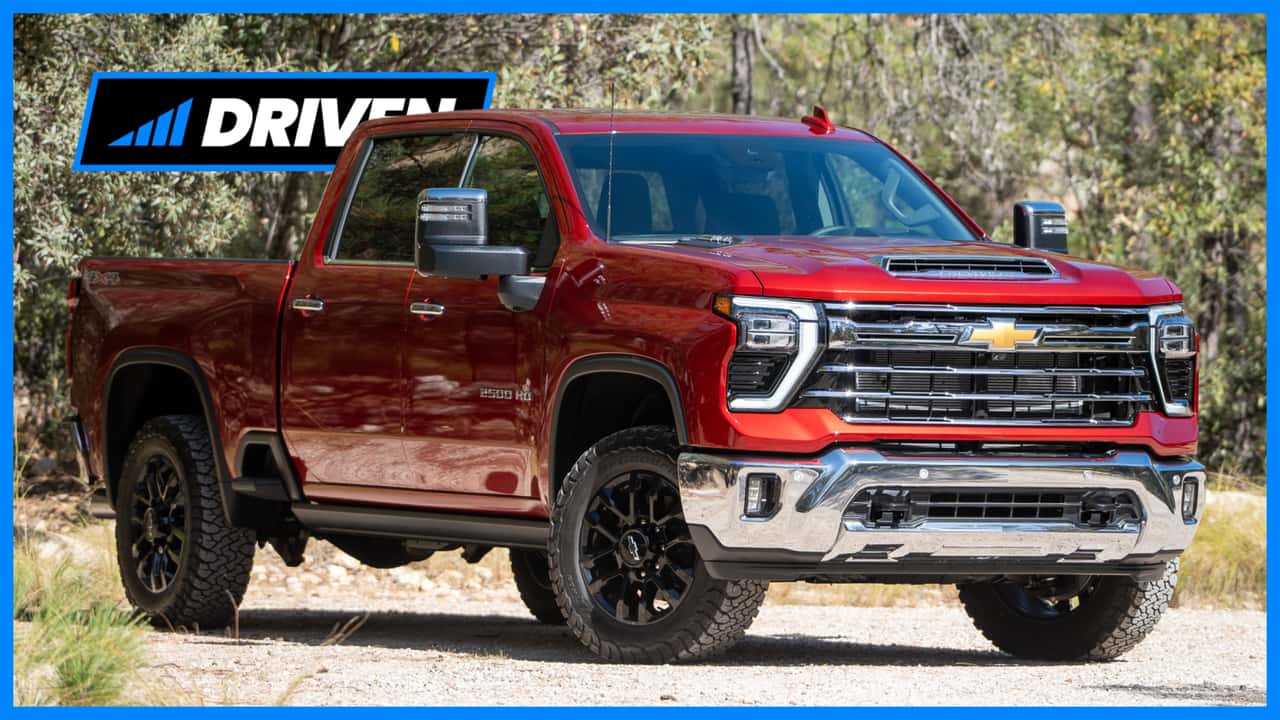

If you’re looking at the above image and thinking, “Hey, wait a second, that looks just like the current Chevrolet Silverado HD,” you’d be right. No need to adjust your monitor, because all of that sheet metal is carryover from the 2026 truck. That doesn’t mean there isn’t a lot of new stuff going on beneath the surface, though.
In fact, while Chevrolet isn’t restyling its heavy-duty trucks until the 2028 model year, it’d be best to think of the 2027 Silverado HD as the prologue for that new pickup. New and upgraded engines, significant changes to the steering and brake systems, smarter drive modes, and a more comprehensive suite of cameras arrive for 2027 with the sole goal of making customers just that little bit more confident in not just their truck’s abilities, but their own.
We set out in the mountains northeast of Tucson, Arizona, to see what it’s all about.
Is There Such A Thing As 'Too Much Torque?'

Let’s first talk about that new diesel engine, because in a world where electrification is increasingly common—even amongst red-blooded pickup trucks—an all-new engine is worth remarking upon. And what an engine it is: an 8.3-liter turbodiesel V8 that was developed, designed, and is built in-house by Chevrolet.
The Silverado HD is only one of two cars on the planet with an 8.3-liter engine. The other is the Bugatti Tourbillon. There is no production vehicle with a larger combustion engine, and in fact we need to look back to the long-dead Dodge Viper and its 8.4-liter V10 to find something of greater displacement.
And much as the Tourbillon provides comical amounts of horsepower, the Silverado HD’s Duramax V8 provides comical amounts of torque. Up to 1,230 lb-ft is at the disposal of the Silverado driver’s right boot, and the only vehicles on the market with more come from brands like Koenigsegg and Bugatti Rimac.
The turbodiesel V8s from Ford and Ram have to make do with just 1,200 and 1,075 lb-ft, respectively. On horsepower, meanwhile, the Silverado’s 555 ponies also exceed the competition, which offer just 500 and 430 hp. So, Chevy has clearly won today’s bench race.
You’d be forgiven for imagining that having enough torque to stop continental drift would be intimidating. In fact, the industry’s largest combustion engine is a relative pussycat, with a very predictable and easy-to-manage throttle.
Squeeze the gas pedal, and there’s an unquestionable surge of torque, but it’s less tsunami and more tide coming in. Even under wide-open throttle, it’s almost surprising how calm and undramatic things are. That’s because, according to Chevy, the team took the opportunity to develop a new engine to focus on refinement as well as performance. A new combustion system, integrated intake design, and the generally new architecture mean an ear-pleasing reduction in NVH.
Chevy has also massaged the Silverado HD’s gas option, a 6.6-liter V8 with 412 horsepower and 472 lb-ft of torque. But with respect, we can’t imagine sitting at the dealer and ordering an HD pickup with anything but a diesel. That’s especially true because opting for the Duramax mill means up to 38,000 pounds of towing capacity via a gooseneck trailer (or 20,000 pounds conventionally).
The gas engine, meanwhile, is good for up to 19,000 pounds, although its 6,990-pound payload capacity exceeds the Duramax’s 6,170 lbs. That’s worth noting if your application prioritizes using the bed versus using the hitch. Both engines work alongside an Allison 10-speed automatic transmission that’s slick as a bowling ball covered in Crisco.
Confidence Beyond Performance
If Chevy had merely added two new powertrains to the Silverado HD’s lineup, it might not be worth remarking upon. But it made far more consequential changes to the steering and the brakes.
Silverado HD is the first vehicle in its class to adopt electric power steering and adds a new rack-and-pinion design, which replaces both the hydraulic power-assisted steering and recirculating-ball design. Model year 2027 is also the first time an HD truck maker has used electronic brake-boosting technology, or “E-Boost Braking,” as Chevy’s marketing gurus have dubbed it. So, why are these two things so important?
On the surface, it seems to be about efficiency and reliability. In both cases, an electric motor replaces a conventional part of the steering’s hydraulic elements and the brake system’s vacuum-assisted booster. Both changes improve efficiency, performance, and reliability (just ignore GM’s recall of 1.16 million E-Boost-equipped cars earlier this year).
Silverado HD is the first vehicle in its class to adopt electric power steering and adds a new rack-and-pinion design, which replaces both the hydraulic power-assisted steering and recirculating-ball design.
It all comes down to tunability. Like replacing analog with digital, replacing old hydraulic systems with electric elements introduces more control. Engineers can now adapt the systems to individual vehicle elements, rather than letting them simply exist in a steady state. Now, the Silverado HD can adjust the steering and braking behavior to account for the vehicle’s drive mode, load status, accelerator input, or any number of other factors. Engineers now have the toolkit to provide owners a level of consistent performance that’s hard to overstate.
But think about it like this: if you spend most of your time unloaded on a level grade in sunny weather, wouldn’t you want the steering and brakes to feel the same when you’re towing 20,000 pounds down a steep grade in the rain? Exactly.
And that brings us to the updated drive modes for Silverado HD. Each manages the powertrain, steering, brakes, and chassis systems to optimize performance and deliver consistent behavior. The most consequential for this truck’s mission is Tow/Haul, which means additional brake boost and steering assistance, in addition to revised throttle mapping, transmission behavior, and exhaust brake performance.
Tow, Tow, Tow Your Boat Camper…
And that brings us to our main event: towing. To maximize our discomfort, we moved directly from the half-ton Silverado and into the HD with a 23-foot travel trailer on the back. No warm-up, no practice, and no time to become acclimated to its size or performance, although we did bring a pair of Chevy towing experts to explain how to best leverage the camera systems (and to make sure we didn’t ding up the six-figure rental camper). Tow/Haul mode activated, we set off.
Negotiating the twisting 1.5-lane roads of our base camp in the Rose Canyon Campground northeast of Tucson showed the added low-speed agility of the new steering system. It required very little effort but also proved highly predictable. Towing is most stressful in these sorts of situations, where small mistakes can have costly results, but we felt basically no anxiety navigating our way to the main road.
As we climbed toward Mt. Lemmon, Arizona, and passed 8,100 feet on a narrow-ish two-lane road, it wasn’t the immense torque of our Silverado HD High Country and its Duramax engine that surprised (our travel trailer was well south of the Silverado HD’s 20,000-pound conventional towing limit), but the sheer degree of precision from the redesigned steering system. It allowed us to place the trailer exactly where we wanted it while rounding a corner, thanks to the predictable weight and variable ratio.
The steering was well isolated, too, meaning that we didn’t experience any shimmying from the load at the back, while the tiller weighted up and down predictably when entering or exiting corners. Had it not been for our mirrors or cameras (more on that in a minute), we might have forgotten there was a trailer at the back.
While the strong engine brake meant we rarely had to dig into the friction brakes, when the time came, the pedal was confident and returned solid stopping power. There was no grabbiness through the pedal or uncertainty about where the tip-in point was, while modulating the pedal into the corner—even while driving downhill—was easy, with consistent performance via our right foot. More impressive is that we had enough confidence in both the engine brake and steering to manage some of the turns on the mountain without the friction brakes at all. Not only did the Silverado handle its load well, it also tended to drive smaller than an HD truck should.
Along our towing journey, the Silverado’s excellent camera system was there to provide peace of mind. The Silverado has up to 14 different camera views, and it pairs the conventional, such as a blind-spot monitor, with some clever tricks.
For example, drivers can select their preferred camera views and lock them into the central touchscreen—opt for a constant view of your blind spot, and the camera’s view will pivot as the front wheel turns, increasing your viewing angle while negotiating bends. Flip on the turn signal and a red box appears on screen to highlight what your mirrors can’t see. And a Transparent Trailer view shows the rear view that your trailer is obstructing. There’s a stunning sense of awareness that comes when towing with a Silverado HD and using all of these systems.
On our drive back to Tucson, we switched back to Normal and were again reminded how good the revised steering was. While it’s no Miata, the big truck was an entertaining dance partner on the winding roads back to town. Again, the steering had such a high degree of predictability and such a pleasant weight that we felt comfortable enough to drive this heavy-duty truck as if it were something much smaller and lighter.
Verdict: The Silverado HD Makes Confidence And Towing More Accessible
This is not to say that all is sunshine and buttercups. While the Silverado HD will arrive in dealers later this year, Chevrolet still hasn’t officially announced pricing (though, there are reports out there). We’ll remind you that as you’re reading this, it’s currently November 10. There’s a pretty clear expiration date on "later this year."
And Chevy’s improvements to the Silverado HD don’t extend beyond the hardware. That’s most egregious in the cabin, which feels incredibly dated after sampling the redesigned half-ton Silverado. Smaller screens, an overabundance of buttons, and a dearth of the high-quality materials that made the smaller truck so appealing mean the top-end Silverado HDs are a decidedly more difficult sell.
But these are ultimately small gripes. And if you disagree, simply wait until this time next year for the redesigned Silverado HD to appear. For now, though, know that a near next-gen towing experience is available today. The 2027 Silverado HD takes an intimidating concept and slashes away at the complexities and unpredictability of it until what remains feels simple, and easy, and maybe even a little mundane.
Especially for new campers or haulers or towers, this is the first truck you should consider.
Silverado HD Competitors
More Silverado Reviews
2027 Chevrolet Silverado HD
RECOMMENDED FOR YOU
From Detroit To Tokyo: Where Every Major Automaker Calls Home
The Reason Your Brain Doesn't Like Driving A CVT
GM Patents A Camera That Watches The Drag Strip Lights And Automatically Launches Your Car
Holy Crap: The Ford Mustang Cobra Is Coming Back
This Corvette ZR1X Has A $400,000 Markup. The Dealer Calls It 'Extreme Exclusivity'
KTM X-Bow Unveils Arrow: A 330-HP Side-By-Side UTV With Audi Power
Forget The Z06. This Is The Used C7 Corvette You Should Buy