Can Anything Stop This Giant-Tired Sherp Off-Roader? These YouTubers Find Out
Shaun Walford and Dave tackle Whiteswan Lake and an overgrown swamp loop in Saskatchewan to test the Sherp's limits.
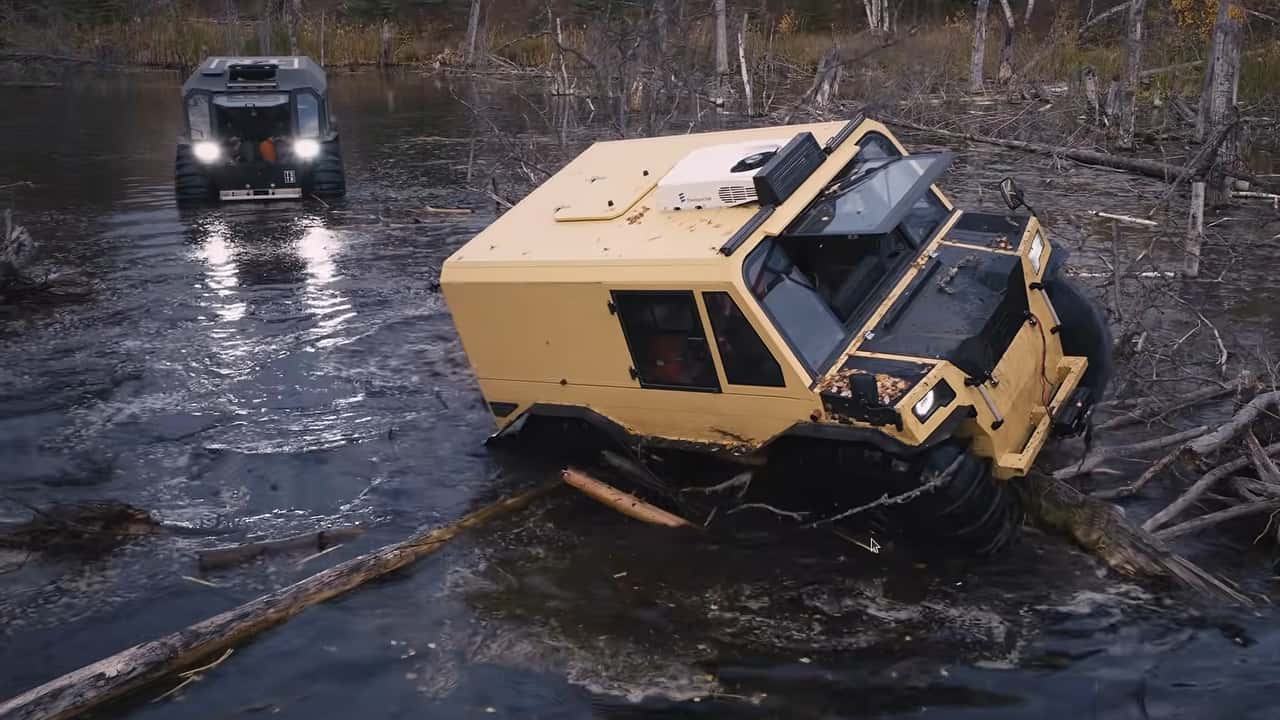

Shaun Walford and Dave from Ostacruiser headed into northern Saskatchewan to find out if anything could stop a Sherp. The amphibious off-roader has a reputation for shrugging off terrain that ends most trail rides early.
The pair documented the trip for Walford's The Story Till Now YouTube channel, running the machine from an open lake into a swamp choked with submerged logs and years of unchecked brush.
Dave knew the route, a loop his local off-road club had used until roughly six years ago, before the trail grew back over. "When no one clears the trail, all this brush grows up and it just swallows the trails," he said, explaining why a six-year-old path had all but vanished.
Exploring Saskatchewan's Lakes By Sherp

Sherp Amphibious Off-Road Vehicle In Saskatchewan
The day started calmly at Whiteswan Lake, where the Sherp's amphibious design let it roll straight from dry ground into open water without pausing. The vehicle's oversized, ultra-low-pressure tires double as flotation, helped by about 44 horsepower and a quoted top water speed of roughly 3.7 mph.
On land, the same Sherp is rated for about 25 mph and can reportedly climb a 35-degree incline. Those numbers explain why it handles stumps and logs that would hang up a standard 4x4. The larger Sherp Pro variant measures about 133 inches long and 99 inches both wide and tall, riding on tires roughly 70 inches tall that can reportedly climb obstacles up to a meter across.
The lake crossing gave both drivers a deceptively gentle start to the day. Clear water let them see straight to a sandy bottom at times.
Walford admitted the visibility made the experience feel "more eerie" rather than safer, since judging depth through clear water is harder than it looks.
Pushing The Sherp Through Swamps
Sherp Amphibious Off-Road Vehicle In Saskatchewan
The relaxed lake crossing ended the moment Dave led the convoy onto the overgrown trail. He had warned that cut stumps, not deep water, were the real hazard. Hitting a stump with the tires lets it roll away, but getting hung up underneath can stop the vehicle outright.
Dave had a story ready to back that up. On a prior trip, a submerged log trapped a Sherp between the log itself and a root system, and the group needed a winch to pull it free. That kind of recovery tracks with general guidance on winch capacity, which recommends a rated load of at least 1.5 times a vehicle's gross weight as a basic starting point.
Once inside the swamp, the trail effectively disappeared under floating vegetation and standing water. One Sherp got briefly stuck while the other pushed through mud, timber, and what Walford called "swamp foam," the churned-up surface left behind after a vehicle forces its way through thick muck.
Neither machine needed a winch that day, despite repeated moments where the Sherps pitched and rocked over hidden obstacles.
Dave summed up the terrain simply: he would look at a stretch of swamp and think, "There's no line there," then watch the Sherp find one anyway.
More From Sherp:
Source: The Story Till Now
RECOMMENDED FOR YOU
Jeep's New Wrangler Scrambler SRT Is A V8-Powered Off-Road Beast
Dodge's New Hellephant Crate Engine Makes 1,025 HP And Comes With A Warranty
The Honda Passport Is Going Baja Racing
Want A Ferrari Luce? You'll Have To Wait Until 2028
Jeep’s Most Popular Gladiator Upgrade Is Finally Available From The Factory
Forget The Sprinter. Someone Made A Cute New Kia Electric Camper Van
Mitsubishi Turned The Outlander Into An Off-Road SUV For SEMA