Someone Stuffed A 13-Rotor Engine Into A Miata. And Yes, It Actually Runs
Rob Dahm's Miata pairs a 12-rotor engine with a single-rotor to roll into Haltech's 2026 SEMA booth.
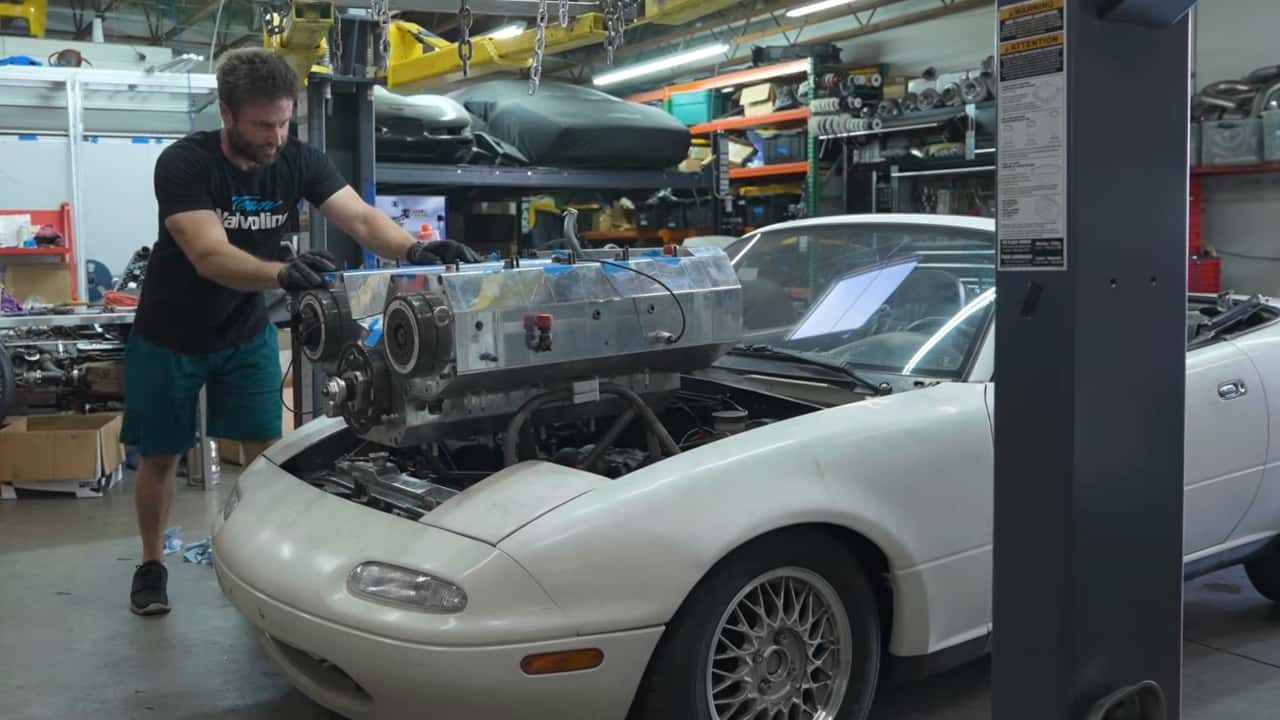

YouTuber Rob Dahm put 13 rotors in a Miata—and somehow, the thing actually runs. Known for shoehorning increasingly absurd engines into first-generation MX-5 chassis, Dahm brought his latest creation to the 2026 SEMA Show in Las Vegas, where it garnered a whole lot of attention.
The car pairs a 12-rotor engine up front with a separate, single-rotor engine that does the actual work of moving the car, for a combined 13 rotors and four turbochargers. Haltech, the engine management company sponsoring the build, asked Dahm to bring something to its SEMA booth.
He decided one rotor, or even twelve, simply wasn't enough.
So, Why Two Separate Rotary Engines?
The trick behind Dahm's 13-rotor Miata is that the massive 12-rotor engine sitting where a normal motor would go doesn't actually power the car. A smaller single-rotor engine, fitted with a Garrett GBC22 turbocharger, handles propulsion while the 12-rotor sits on top purely for display.
Dahm's team kept wiring, fuel lines, and accessories in place on the 12-rotor so it looks fully functional, but it's not connected to the drivetrain at all. The goal was to make onlookers question how any of it works rather than spotting an obvious missing part. The 12-rotor engine has a claimed output of 4,500 horsepower.
Cramming The Drivetrain Into A Tiny Engine Bay
Fitting a 12-rotor engine and a running single-rotor engine into a Miata engine bay meant building custom mounts from scratch, triangulated into the chassis to resist both side-to-side wobble and a teeter-totter motion from the engine's weight distribution.
Turbochargers, intake manifolds, and fuel rails all had to go back on in a specific order, partly because some components helped brace others against the chassis. Three turbochargers in total went onto the combined setup, adding roughly 70 pounds apiece on top of an already overloaded front end.
The team reused components built for earlier Dahm projects, including labeled wiring harnesses from past builds, since reconstructing everything from zero in the available time wasn't realistic.
A Tight Deadline And The SEMA Debut
Before the car could run, it had to roll; the team treated that milestone as its own test.
Getting the car into a trailer created its own crisis, with the team debating ground clearance against a steep ramp while the rear end slid sideways under the shifted weight. Loading success came down to careful measurements and a willingness to risk scraping the undercarriage on the way up.
The 2026 SEMA Show runs November 3 through 6 in Las Vegas, and the finished build is on display at Haltech's booth in the Central Hall for the full four days. Dahm's team confirmed the engine fires up and the car moves under its own power, even if the 12-rotor on top never needs to.
More Insane Builds
RECOMMENDED FOR YOU

Two Porsche 911S Get Wild V8 Swaps At SEMA
October Winners And Losers: Mazda Surges As Mustang Sales Slide
Ford’s 1,200-HP Bronco Is Built For Arctic Rescue
Mid-Size Trucks Are Booming. Now Everyone Wants In
This Porsche 911 Engine Teardown Gets Worse The Deeper It Goes
Buick Has A Sleek New Hybrid Sedan. But Not For America
Mazda Is Quietly Killing One Of Its Most Unusual Engines